
Watch and antique clock repair in Delhi,
A working Delhi bench, not a collection counter. Every repair is quoted before it is started — and for an antique clock that should not travel, we bring the tools to you.
- Five decades at the bench Fifty years and more of watches and clocks through the same workshop.
- Free estimate first You hear the cost before anything is opened. No surprise bills.
- Antique clock specialists Longcase, mantel and cuckoo movements, restored traditionally.
- We travel across Delhi-NCR For a clock that should not be moved, the bench comes to you.
Nine things we do, and do properly.
A battery takes minutes. A longcase movement can take weeks. Both get the same bench and the same attention.
Watch Repair
From a stopped quartz movement to a mechanical calibre that needs stripping down, we repair every type of watch — luxury brands included.
Read moreWatch Servicing & Overhaul
A full service: the movement is dismantled, cleaned, lubricated, regulated and timed before it goes back on your wrist.
Read moreWatch Battery Replacement
A stopped watch is most often a flat cell. We fit the correct battery, check the gasket and reseal the case.
Read moreAntique Clock Restoration
Traditional techniques and traditional materials, so the clock keeps both its authenticity and its value. We come to you when a case should not travel.
Read moreClock Repair & Maintenance
Stopped, gaining, losing, or simply long overdue a clean — we get the movement running true again and keep it that way.
Read moreDial Refinishing
The dial is the face of the timepiece. When it has faded or been damaged, we refinish it without losing its character.
Read moreCrystal & Glass Replacement
A cracked or scratched crystal is more than cosmetic — it lets dust and moisture reach the movement. We fit a new one and reseal.
Read moreStrap & Bracelet Replacement
A worn strap is the most common reason a good watch stops being worn. We fit a replacement to your lug width and style.
Read moreWatch Engraving
A name, a date, a few words on a case back. It costs little and it is what makes a watch worth passing on.
Read more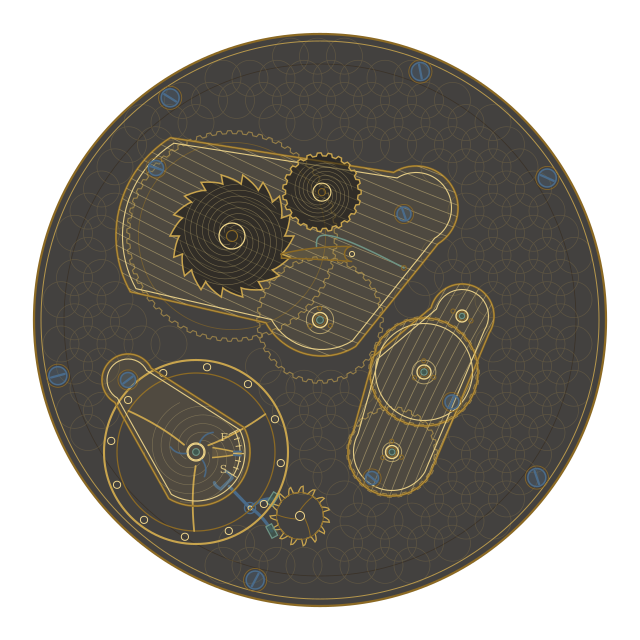
What you are actually handing over.
A mechanical watch is a power source, a gear train and a governor, built to tolerances measured in hundredths of a millimetre. Dried oil in any one of these places wears metal that cannot be un-worn.
- 1Crown & stem
- Winds the mainspring and sets the hands. The commonest route for water to get in.
- 2Mainspring barrel
- Stores the power. A tired or set mainspring is why a watch stops early.
- 3Gear train
- Steps that power down through four wheels into an even, usable rate.
- 4Escapement
- Releases the train one beat at a time. This is the ticking you can hear.
- 5Balance wheel
- Oscillates against a hairspring and decides whether the watch keeps time.
- 6Jewel bearings
- Synthetic ruby. They cut friction where a steel pivot would grind itself away.
From your wrist to the bench and back.
Five steps, and you know the price before step four.
- 01
You get in touch
Call, WhatsApp a photo, or bring the piece to the workshop. For a large clock, we arrange a visit.
- 02
We look properly
The movement is opened and inspected. Guessing from the outside is how good timepieces get ruined.
- 03
You get a price
A written estimate covering parts and labour, with a realistic timeframe. Free, and never binding.
- 04
The work is done
Cleaning, lubrication, part-making or restoration — by hand, at the bench, using the right materials.
- 05
It is timed, then returned
We run it and regulate it before it goes back to you, so it leaves keeping time, not just ticking.
An antique clock is a document, not just a machine.
Brass goes green, steel pits, and somebody in 1960 fitted the wrong bush. Restoring a clock properly means reversing that without erasing the evidence of its life. We use traditional techniques and traditional materials, so the clock keeps its authenticity — and its value.
Longcase and grandfather · Mantel and bracket · Cuckoo · Wall regulators
Antique clock restorationRepairing an antique clock is not only about the mechanism. It is about keeping a piece of history running for the next generation.
A longcase clock does not travel like furniture.
Most of the damage we repair on grandfather clocks did not happen while they were running. It happened in the back of a vehicle. Here is what a proper move actually involves, so you can see why we would rather bring the bench to the clock than have the clock come to us.
- 1
The pendulum comes out first
It is steadied, then unhooked from the suspension spring. That spring is a thin strip of steel, and it bends if the bob is left swinging.
- 2
The weights come down and get labelled
They are wound low, lifted off and marked. Weights are rarely identical, and the strike train will not run correctly if they go back swapped.
- 3
The hood lifts, the movement is freed
The hood generally slides forward off the trunk. With it clear, the movement lifts from the seatboard and travels on its own.
- 4
The case travels upright, never flat
Empty, the case is light but awkward, and the glass and cresting are the first things to break. Two people, upright, and never laid flat in a car boot.
The bench is in Delhi. The work comes from all over India.
Delhi-NCR we cover in person, and for an antique clock we come to the house. Everywhere else in the country, the piece travels to us instead. Send a photograph first and we will tell you whether it is worth the journey before you arrange anything.
We would rather you read the reviews on Google.
Anyone can write glowing quotes on their own website. Ours are on our Google Business Profile, where we cannot edit them and neither can anyone else. Read what people actually said, then decide.
Tell us what has stopped.
A photo on WhatsApp is usually enough for us to tell you what is likely wrong and what it will cost. Open Mon – Sun, 09:00 – 18:00.